Service Dogs in Massachusetts: Training, Access Rights and Where to Start
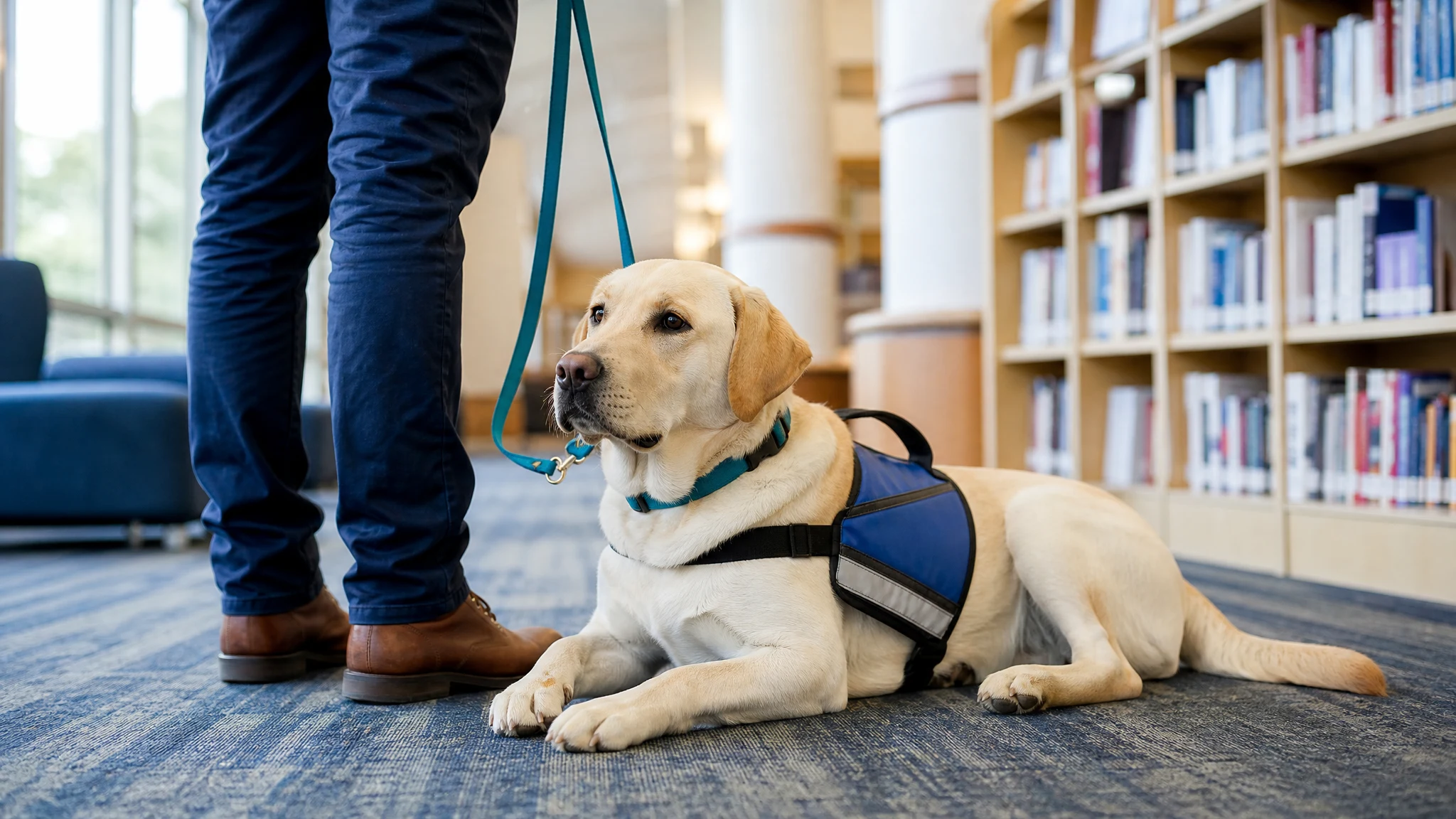
This page explains the law in general terms. It is not legal advice. For a specific situation, contact the agency listed on this site or an attorney.
A service dog can change how a person with a disability moves through daily life. In Massachusetts, the rules that shape that life come from two places: the federal Americans with Disabilities Act (ADA) and the Massachusetts General Laws. This guide explains both in plain English. It also covers the two main ways people get a dog, what training involves, what is known about cost, and the Massachusetts organizations worth contacting first.
This is an explainer, not legal advice. Where a detail depends on an agency or a program, the guide says so and points you to the source.
Key takeaways
- Under the ADA, a service dog is a dog individually trained to do work or perform tasks for a person with a disability (ADA.gov Service Animals FAQ).
- Emotional support, therapy and comfort animals are not service animals under the ADA.
- There is no official service dog registry and no required certification under the ADA. Registration papers and ID cards sold online are not legal proof.
- Massachusetts law builds on the ADA. M.G.L. c. 272, s. 98A protects access for people with a dog guide, and c. 129, s. 39F gives people raising or training a service dog the same rights as an individual with a disability under the ADA.
- Most people get a dog one of two ways: from a program that trains the dog, or by training the dog themselves, often with a trainer's help.
- Fees, waitlists and eligibility vary by organization. Ask each program directly.
In this guide
- Who qualifies: the ADA definition
- What Massachusetts law adds
- Two routes: program-trained or owner-trained
- Massachusetts organizations to know
- What service dog training involves
- Costs and funding
- How to get a service dog in Massachusetts: where to start
- Sources
Who qualifies: the ADA definition
The ADA is a federal civil rights law, and it sets the baseline everywhere in Massachusetts. The ADA.gov Service Animals FAQ defines a service animal as a dog that has been individually trained to do work or perform tasks for an individual with a disability.
Two parts of that definition matter most. The first is the disability. The second is the training. A dog that is simply friendly, well behaved or comforting does not meet the definition. The dog must be trained to do something specific that relates to the person's disability.
What counts as work or tasks
The work or tasks are the heart of the definition. The programs listed later in this guide describe the kinds of help Massachusetts dogs are trained to give, including assisting with hearing, mobility and balance, autism-related needs and PTSD. Your own list of tasks depends on your own needs and on what a dog can be reliably trained to do.
What does not count
Emotional support animals, therapy animals and comfort animals are not service animals under the ADA. Their presence may be valuable, but the ADA public access rules do not cover them. Keeping that line exact protects people who rely on trained service dogs, and it protects you from relying on a right you do not have.
No registry and no required certification
The ADA does not require a service dog to be registered, certified or issued an ID. No official national or Massachusetts registry exists in the sources reviewed for this guide. You do not need to register or certify your dog to have one.
Websites that sell certificates, vests or ID cards cannot make a dog a service dog, and an online registration is not legal proof of anything. Spending money there will not give you legal access rights.
The two questions staff may ask
When it is not obvious that a dog is a service animal, the ADA.gov Service Animals FAQ says staff may ask two questions:
- Is the dog a service animal required because of a disability?
- What work or task has the dog been trained to perform?
Those are the questions the FAQ describes. The FAQ is also the place to read how the ADA treats other points, such as control of the dog and removal of a dog from a business. Read it in full at ADA.gov before you start working with a dog in public.
What Massachusetts law adds
Massachusetts has its own statutes on access, discrimination and training. They work alongside the ADA. This section describes what the statutes say, based on the Massachusetts General Laws at malegislature.gov.
Public access: M.G.L. c. 272, s. 98A
Section 98A gives blind, deaf, hearing-handicapped and other physically handicapped persons accompanied by a dog guide the same access to public conveyances, amusements and places of public accommodation as other people have. No extra fare or charge may be imposed for the dog.
The penalty for a violation is a fine of up to $300, plus damages to the aggrieved person under c. 151B, s. 5, with a civil forfeiture of at least $100.
One point deserves care. The wording of section 98A, as reviewed for this guide, speaks of a "dog guide" and does not use the words "service animal." It is narrower in language than the ADA definition. The ADA applies on top of it, so a person with a service dog under the ADA definition is not left without protection.
Disability discrimination in public places: c. 272, s. 98 and s. 92A
Section 98 separately treats disability discrimination in places of public accommodation as a civil right. Under it, the Massachusetts General Laws set a fine of up to $2,500 and/or up to one year in prison. Sections 98 and 92A are the state's public accommodation discrimination provisions, and they include disability.
Raising and training: c. 129, s. 39F
Section 39F covers people who are raising or training a service dog. It says a person accompanied by and engaged in the raising or training of a service dog, including hearing, guide or assistance dogs, has the same rights, privileges and responsibilities as an individual with a disability under the ADA.
Based on the text reviewed, the statute is not limited to professional trainers, and no age, harness or ID conditions appeared in it. Section 98A itself does not mention training. The full text of section 39F was read through the Animal Legal and Historical Center's compilation of Massachusetts assistance animal laws, and the Massachusetts legislature's page confirms the opening phrase. Check the current text at malegislature.gov before relying on a detail.
Housing: c. 151B, s. 4
Chapter 151B, section 4, paragraphs 6 and 7, bar housing discrimination because a person is blind, hearing impaired or has any other handicap, or possesses a trained dog guide as a consequence of blindness or hearing impairment. If you need your dog in rental housing, the landlord's duties can also involve federal housing law, so check HUD guidance for how that works and ask the relevant agency about your situation.
Employment: c. 151B, s. 4
Paragraph 16 of the same section bars employers from discriminating against a handicapped person who can perform the essential functions of a job with reasonable accommodation, unless the accommodation would cause undue hardship. The statute has no service-animal-specific language. Whether a dog can accompany you at work is a question about reasonable accommodation, so raise it with your employer in writing and ask the agency that handles employment complaints about next steps.
Air travel
Air travel with a service dog falls under U.S. Department of Transportation rules, not Massachusetts law. Check the DOT's current requirements and your airline's process well before you fly.
Penalties for misrepresentation and where to complain
This guide could not confirm a Massachusetts penalty for falsely claiming a pet is a service dog. Do not assume one exists or does not exist. A bill, H.1686 in the 194th General Court, would only create a study commission, and it was last shown as referred to the Judiciary committee.
Likewise, this guide could not verify the Massachusetts agency, filing steps or deadlines for a discrimination complaint. Check the official Massachusetts state website for the current agency and process, and read ADA.gov for the federal complaint options. Deadlines can be short, so look this up soon after an incident rather than later.
Two routes: program-trained or owner-trained
There is no single required path to a service dog. In practice, people tend to take one of two routes. Neither is better for everyone, and the ADA definition applies to both: the dog must be individually trained to do work or tasks for a person with a disability.
Route one: a dog trained by a program
Nonprofit programs breed, select or acquire dogs, train them and place them with an approved applicant. You apply, the program reviews your needs, and if you are accepted you are matched with a dog and trained to work with it.
Some programs hold accreditation from Assistance Dogs International (ADI). The ADI member search for Massachusetts lists NEADS Service Dogs, for example. Accreditation is one thing you can ask any program about.
What to weigh:
- Programs usually focus on certain disabilities, so one may fit your needs and another may not.
- Waitlists and fees differ. The sources reviewed for this guide did not list waitlist lengths, so ask each program.
- You usually have less say in the dog's breed or background, and more support from experienced staff.
Route two: an owner-trained dog
In an owner-trained route, you train your own dog, often with help from a professional trainer or classes. The dog may be one you already have or one you select for the job. The ADA does not require a particular trainer or program, which is part of why this route exists.
What to weigh:
- You carry the responsibility for the dog's temperament, health and training plan.
- Not every dog is suited to public access work, however much you love it. Honest evaluation matters.
- The work is long and demanding, and your disability may affect how much of the training you can do alone.
Massachusetts c. 129, s. 39F gives a person raising or training a service dog the same rights as an individual with a disability under the ADA, and the text reviewed does not limit this to professional trainers. That is relevant to owner-trainers, who need to take the dog into public places to practice. Read the statute itself so you understand its terms.
Which route fits
Ask yourself a few plain questions. What tasks do I need the dog to do? How much training can I take on, physically and financially? Do I have a dog that could suit this work? How long can I wait for a placement? Your answers will usually point toward one route, or toward contacting a program and a trainer before you decide.
Massachusetts organizations to know
The programs below appear in the sources reviewed for this guide. This is not a complete list, and inclusion is not an endorsement. We have not tested or reviewed any of these programs. Confirm details, eligibility, fees and wait times directly with each organization.
| Organization | Location | Who it serves | Cost, as stated |
|---|---|---|---|
| NEADS World Class Service Dogs (NEADS Service Dogs) | Princeton | Hearing, mobility, autism, veterans, PTSD (military) | Not stated in sources; ask NEADS |
| Dogs for Better Lives (Northeast Campus) | East Falmouth | Hearing, autism, facility dogs for professionals | Placed free of charge, per its website |
| Mobility Danes of New England, Inc. | Ipswich | Mobility and balance | Dogs donated free of charge, per its website |
| Canines For Disabled Kids, Inc. | Worcester | Children under 18 (scholarship help toward a service dog) | Not stated in sources; ask the organization |
| K9 Mission Inc. | Shrewsbury | Veterans with PTSD | Not stated in sources; ask K9 Mission |
NEADS World Class Service Dogs
NEADS is based in Princeton. The Assistance Dogs International member search for Massachusetts lists NEADS Service Dogs as an accredited member, with dog types listed as hearing and service dogs, and disabilities listed as autism, mobility and PTSD (military). Visit neads.org for current information.
Dogs for Better Lives
Dogs for Better Lives has a Northeast Campus in East Falmouth. Its website says dogs are placed free of charge, states there are no application fees or good faith deposits, and says the client is financially responsible for the dog's care after placement. Its page shows an ADI accredited logo. See dogsforbetterlives.org.
Mobility Danes of New England
Formerly the Service Dog Project, this Ipswich nonprofit focuses on mobility and balance. Its website says its dogs are donated completely free of charge. Visit mobilitydanesofnewengland.com.
Canines For Disabled Kids
This Worcester nonprofit funds scholarship assistance toward obtaining a service dog for children under 18. It funds dogs from other programs rather than being listed here as a placement program itself. Because details could not be fully verified, search for the organization's current contact information and confirm it is the genuine site before sharing any personal details.
K9 Mission Inc.
K9 Mission in Shrewsbury places service dogs with veterans who have PTSD. See k9mission.org.
Other help for veterans
NEADS describes its Service Dogs for Veterans program as training service dogs for service men and women with disabilities or PTSD, and as the first program in the country dedicated to service dogs for wounded veterans. Read more at neads.org.
The U.S. Department of Veterans Affairs does not provide dogs. Its Service Dog Veterinary Health Benefit provides veterinary insurance, hardware and travel for one service dog at a time for eligible Veterans with visual, hearing or substantial mobility impairment, when the dog was trained by an ADI or IGDF accredited organization. At Massachusetts VA medical centers, it is handled through the Prosthetic and Sensory Aids Service. Details are on the VA's service and guide dogs page.
If your need is not covered by the programs above, ask them for referrals, and check the ADI member search for Massachusetts for other accredited members.
What service dog training involves
Whatever route you take, training has the same broad parts. The ADA definition requires the dog to be individually trained to do work or tasks, so task training is not optional. Public behavior matters too, because a dog that cannot settle in a store or on a bus cannot do its job there.
Humane, reward-based methods
Training should be humane and reward-based, in line with the American Veterinary Society of Animal Behavior (AVSAB). That means rewarding the behavior you want with food, play or praise. It does not include shock, prong or choke collars, alpha rolls, scruffing or dominance methods. Aversive methods can create fear and stress, which works against a dog that needs to stay calm in busy places.
If a trainer proposes any of those methods, find another trainer.
The building blocks
- Foundation skills. Sit, down, stay, come when called, loose-leash walking, settling on a mat, and polite greetings, taught at home first.
- Socialization and confidence. Careful, positive exposure to people, surfaces, sounds, and other animals, at a pace the dog can handle.
- Task training. Teaching the specific tasks that help with your disability, such as retrieving items, alerting to a sound, providing bracing or balance support, or interrupting certain behaviors. Tasks are taught in small steps and reinforced until reliable.
- Public access training. Practicing in progressively busier places: quiet stores first, then crowded ones, ignoring food on the floor, dogs and people who try to pet or distract.
- Maintenance. Training does not end. Skills need regular practice, and health checks matter because pain can change behavior.
Temperament and fit
Not every dog becomes a service dog. A dog that is fearful, reactive or easily distracted may be a poor match for the work, and forcing it can harm both of you. Programs screen dogs for temperament for this reason. If you owner-train, an honest evaluation by a qualified reward-based trainer can save you time and heartache.
Training in public, and the law
Massachusetts c. 129, s. 39F gives a person engaged in raising or training a service dog the same rights as an individual with a disability under the ADA. This is what supports taking a dog in training into places where the public goes. Because the text was read through a compiled source, confirm the exact language on the legislature's website. Always keep your dog under control and be a considerate guest, as a business owner's tolerance of a training dog often depends on how it behaves.
Handler responsibilities
Having a service dog carries duties. Keep the dog clean, healthy and under control. Follow local dog licensing rules. Massachusetts c. 140, s. 139, which governs dog licensing, ties the term "service animal" to the ADA definition, so check your city or town clerk for license requirements.
Costs and funding
Cost is one of the first questions people ask, and it is hard to answer in one number. The sources reviewed for this guide do not give a typical price for a Massachusetts service dog, and we will not guess one.
Program-trained dogs
What is known comes from the programs themselves:
- Dogs for Better Lives says its dogs are placed free of charge, with no application fees or good faith deposits. The client is responsible for the dog's care after placement.
- Mobility Danes of New England says its dogs are donated completely free of charge.
- NEADS, K9 Mission and Canines For Disabled Kids did not have cost information in the sources reviewed. Ask each one directly.
Even when a dog is free, you should plan for ongoing costs after placement, such as food, veterinary care, supplies and travel for training.
Owner-trained dogs
If you train the dog yourself, you pay for the dog, veterinary care, equipment, classes or private lessons, and possibly a trainer's time. These costs vary widely. Ask trainers for written fee information before committing, and compare their methods as well as their prices.
Possible help with costs
- Scholarship help for children. Canines For Disabled Kids funds scholarship assistance toward obtaining a service dog for children under 18. Ask the organization about eligibility and amounts.
- VA veterinary benefit. Eligible Veterans with visual, hearing or substantial mobility impairment may qualify for veterinary insurance, hardware and travel for one service dog, if the dog was trained by an ADI or IGDF accredited organization. The VA does not provide the dog.
Be wary of anyone who asks for large payments for "certification" or "registration." The ADA requires neither.
How to get a service dog in Massachusetts: where to start
If you are wondering how to get a service dog in Massachusetts, a clear order of steps helps. None of this is a legal requirement, and you can move at your own pace.
- Clarify your needs. Write down the specific tasks that would help with your disability. A dog's work is defined by tasks, so this list is the foundation of everything else.
- Talk with your own healthcare providers. They know your needs and can advise on whether a service dog fits. A program may ask for documentation as part of its application. The ADA itself does not require a doctor's note for public access.
- Read the ADA.gov Service Animals FAQ. Know the definition and the two questions staff may ask, so you can handle questions calmly.
- Choose a route. Decide whether you want to apply to a program, train a dog yourself, or explore both. The earlier sections can help you weigh the tradeoffs.
- Contact programs. Ask about eligibility, the disabilities and dog types they serve, accreditation, fees, wait times and what happens after placement. Ask more than one program, since each has its own focus.
- If owner-training, find a reward-based trainer. Ask about their methods, and walk away from anyone who uses shock, prong or choke collars or dominance methods. Ask how they would evaluate your dog's suitability.
- Plan for the long term. Think about housing, workplace discussions, travel and the dog's care over its working life.
- Know your rights and where to complain. Read the Massachusetts statutes described above. Confirm the current complaint agency and filing process through official state and ADA.gov pages.
Common mistakes to avoid
- Buying a registration, certificate or ID card and treating it as legal proof.
- Assuming an emotional support animal has public access rights under the ADA.
- Choosing a trainer by price or promises alone.
- Skipping a temperament evaluation for a dog you already own.
- Expecting a guaranteed result. Training outcomes depend on the dog, the handler and the process, and no one can promise them.
A note on questions at the door
Most businesses mean well but may not know the rules. If someone asks the two permitted questions, answer them briefly and calmly. If you are refused, note the date, place and names, stay courteous, and look up the right complaint route. The Massachusetts penalties in c. 272, s. 98A and s. 98 exist because denial of access is treated seriously, but the practical path starts with documenting what happened.
Sources
- ADA.gov Service Animals FAQ
- Massachusetts General Laws, c. 272, s. 98A
- Massachusetts General Laws, c. 140, s. 139
- Massachusetts General Laws, c. 151B, s. 4
- Animal Legal & Historical Center, Massachusetts assistance animal and guide dog laws (c. 129, s. 39F)
- Assistance Dogs International, member search for Massachusetts
- NEADS Service Dogs
- Dogs for Better Lives
- Mobility Danes of New England
- K9 Mission Inc.
- U.S. Department of Veterans Affairs, Service and Guide Dogs