Service Dogs for Veterans in Massachusetts
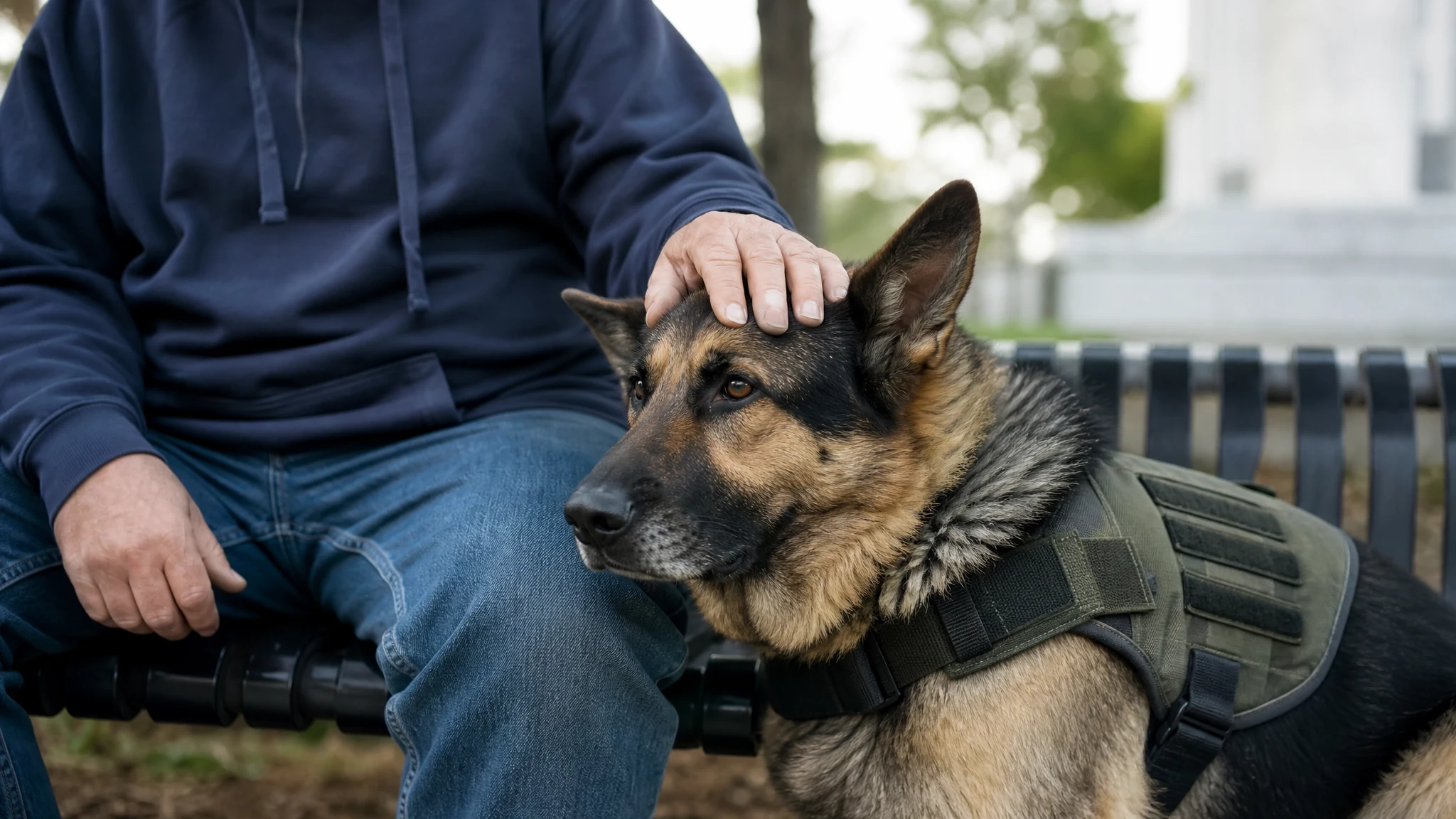
This page explains the law in general terms. It is not legal advice. For a specific situation, contact the agency listed on this site or an attorney.
Many veterans look into service dogs for veterans after a service-connected injury, hearing loss or post-traumatic stress disorder (PTSD). This guide explains how to pursue a service dog in Massachusetts, which programs and benefits are documented, and how federal and state law treat the dog once you have one.
It is a general explainer, not legal or medical advice. Where a detail is not confirmed, the guide says who to ask.
What counts as a service dog for a veteran
The ADA.gov Service Animals FAQ defines a service animal as a dog that has been individually trained to do work or perform tasks for an individual with a disability. The task must relate to the disability.
For a PTSD service dog in Massachusetts, that can mean trained tasks that help with the condition. The dog's training is what makes it a service dog under the ADA. Its breed, a vest or a piece of paper does not.
PTSD service dogs versus emotional support animals
This distinction matters, and the ADA is exact about it. Emotional support, therapy and comfort animals are not service animals under the ADA. A dog whose only role is to provide comfort by being present has not been trained to perform a task.
A dog trained to perform specific tasks for a person with PTSD can qualify. A pet that makes you feel calmer does not, however much it helps. Housing and air travel have their own separate rules, covered below.
What you need before you start
There is no ingredient list here, but there is a checklist. Gather these first:
- Your discharge paperwork (DD-214) and any VA health records you already have.
- A clinician who knows your condition and can talk with you about whether a service dog fits your care. Programs often ask for supporting information, so ask each program what it requires.
- A realistic picture of daily life: housing, work, family, and who can help with a dog's care.
- Time and a budget for ongoing costs. Several programs place dogs free of charge, but the dog's food and veterinary care generally fall to the handler. Dogs for Better Lives, for example, says the client is financially responsible for the dog's care after placement.
- A notebook for questions, dates and the names of people you speak with.
Step-by-step: how to get a service dog as a Massachusetts veteran
Step 1: Decide what tasks you need help with
Write down the specific situations that are hardest. These might be a hearing loss, a mobility or balance problem, or PTSD symptoms that affect leaving the house, sleeping or being in crowds.
Programs train for particular disabilities, so a clear list helps you find a match. It also supports the ADA requirement that the dog be trained to do work or tasks.
Step 2: Talk with your care team
Raise the idea with your VA or private clinician. A service dog is a long commitment, usually eight to ten years or more of daily responsibility. Your clinician may also be asked to provide information to a program.
Step 3: Learn what the VA does and does not provide
The VA does not provide service dogs. Its Service Dog Veterinary Health Benefit, described on the VA Prosthetic and Sensory Aids Service page, covers veterinary insurance, hardware and travel for one service dog at a time.
The VA states that the benefit is for eligible Veterans with a visual, hearing or substantial mobility impairment, and that the dog must have been trained by an organization accredited by Assistance Dogs International (ADI) or the International Guide Dog Federation (IGDF). In Massachusetts, the benefit is handled through the Prosthetic and Sensory Aids Service at VA medical centers.
The VA page as summarized does not list PTSD alone among the qualifying impairments. If PTSD is your main condition, ask your local VA Prosthetic and Sensory Aids Service how the benefit applies to you before you assume either way.
Step 4: Look at the Massachusetts programs
These are the programs documented for Massachusetts veterans. Fees and waitlists are not stated on the sources reviewed, so contact each program directly.
- NEADS Service Dogs (Princeton). NEADS describes its program as training service dogs for service men and women with disabilities or PTSD, and calls it the first program in the country dedicated to service dogs for wounded veterans. The Assistance Dogs International member listing for Massachusetts includes NEADS and lists hearing and service dogs for autism, mobility and military PTSD. Visit NEADS for current application details, cost and waitlist information.
- K9 Mission Inc. (Shrewsbury). K9 Mission says it places service dogs with veterans who have PTSD. Check K9 Mission for eligibility, cost and wait times.
Other Massachusetts nonprofits train dogs for specific disabilities, though the sources reviewed do not describe them as veteran-specific:
- Mobility Danes of New England (Ipswich), formerly Service Dog Project, serves mobility and balance needs. Its website says dogs are donated completely free of charge. See Mobility Danes of New England.
- Dogs for Better Lives (East Falmouth) serves hearing and autism needs and facility dogs for professionals. Its website says dogs are placed free of charge with no application fees or good faith deposits. See Dogs for Better Lives. Ask whether veterans with your needs are eligible.
Information on other accredited members in the state, and on any VA Boston-specific service dog program, was not confirmed. Check the Assistance Dogs International member search for Massachusetts and ask your VA team.
Step 5: Contact programs and ask direct questions
Call or write to two or three programs. Ask:
- Do you serve my specific condition?
- What does the application require, and what is the timeline?
- What are the costs to me, now and after placement?
- How long is the waitlist?
- Is the program accredited by ADI or IGDF? (This matters for the VA veterinary benefit.)
- What training do I receive as the handler, and what follow-up support is there?
Step 6: Complete the application
Expect forms about your disability and daily life, plus supporting information from a clinician. Many programs also ask for an interview. Answer honestly and completely. A program's goal is to match the right dog with the right person.
Step 7: Take part in the matching and handler training
If you are accepted, you will usually be matched with a dog and trained to work with it. Plan to follow any in-person training the program requires. Training should use humane, reward-based methods, in line with the American Veterinary Society of Animal Behavior (AVSAB). Ask any program how it trains, and do not accept shock, prong or choke collars or dominance methods.
Step 8: Apply for VA support if you qualify
If your dog came from an ADI or IGDF accredited organization and you meet the VA's impairment criteria, contact the Prosthetic and Sensory Aids Service at your VA medical center about the veterinary health benefit. The VA describes this as covering one service dog at a time.
Your rights with a service dog in Massachusetts
Federal and state law work together. For a fuller look at both, see our guide to service dog training and access rights in Massachusetts.
Federal law
Under the ADA, staff at a business open to the public may ask only two questions when it is not obvious what the dog does: (1) is the dog a service animal required because of a disability, and (2) what work or task has the dog been trained to perform? You do not have to carry a certificate, and the ADA does not require any registration. For details, see the ADA.gov Service Animals FAQ.
Be wary of websites that sell registrations, ID cards or certificates. The ADA has no official registry or required certification, and an online registration is not legal proof that a dog is a service animal.
Massachusetts law
M.G.L. c. 272, s. 98A gives blind, deaf, hearing-handicapped and other physically handicapped persons accompanied by a dog guide the same access to public conveyances, amusements and places of public accommodation as others. No extra fare or charge may be imposed for the dog. The statute uses the term 'dog guide' rather than 'service animal', and the ADA applies on top of it.
Under the same section, a violation carries a fine of up to $300, plus damages to the aggrieved person under c. 151B, s. 5 with a civil forfeiture of at least $100. Separately, c. 272, s. 98 makes disability discrimination in public accommodations a civil right, with a fine of up to $2,500 and/or up to one year in prison.
For housing, M.G.L. c. 151B, s. 4 bars discrimination because a person is blind, hearing impaired or has any other handicap. For work, paragraph 16 of the same section bars employers from discriminating against a handicapped person who can perform the essential functions of the job with reasonable accommodation, unless it would cause undue hardship. It has no service-animal-specific language.
If you think your rights were violated, the sources reviewed do not confirm which state office takes complaints or what the deadlines are. Check with the Massachusetts agency that handles discrimination complaints on its official website, and consider legal advice.
If you are raising or training your own dog
M.G.L. c. 129, s. 39F gives a person accompanied by and engaged in the raising or training of a service dog the same rights, privileges and responsibilities as an individual with a disability under the ADA. As read, the statute is not limited to professional trainers. Check the current text on malegislature.gov before relying on it.
Tips and common mistakes to avoid
- Do not buy a registration. No registry or certification is required, and paying for one gives you no legal protection.
- Do not confuse support with service. A calming pet is not a service dog under the ADA, even if it helps you. Be honest with yourself and any program about which one you need.
- Do not assume the VA will give you a dog. It does not. It offers a veterinary health benefit for eligible Veterans and accredited-trained dogs.
- Ask about cost before you apply. Several fees and waitlists were not stated publicly, so ask in writing.
- Verify before you rely. Program details change. Confirm accreditation, eligibility and costs with each organization.
- Keep the dog under control. A handler is responsible for the dog's behavior and care in public.
- Use reward-based methods only. Avoid trainers who use harsh tools or dominance techniques.
What results to expect
Outcomes differ for every veteran and every dog. Some handlers report that a trained service dog helps them manage specific tasks, such as being alerted to sounds, getting steadier on their feet, or having a dog trained to interrupt certain symptoms in public. Others find the responsibility of a working dog demanding.
A service dog is not a cure and is not a replacement for care from your clinician. Many people find it works best as one part of a broader plan. Ask each program what it can and cannot promise, and be cautious of anyone who promises specific results.
Sources
- ADA.gov Service Animals FAQ
- Massachusetts General Laws c. 272, s. 98A
- Massachusetts General Laws c. 151B, s. 4
- Animal Legal & Historical Center, Massachusetts assistance animal laws (c. 129, s. 39F)
- Assistance Dogs International member search, Massachusetts
- NEADS Service Dogs for Veterans
- K9 Mission Inc.
- Mobility Danes of New England
- Dogs for Better Lives
- VA Prosthetic and Sensory Aids Service: Service and Guide Dogs