Service Dog Tasks and the Public Access Test, Explained
This page explains the law in general terms. It is not legal advice. For a specific situation, contact the agency listed on this site or an attorney.
Two questions come up again and again for Massachusetts handlers and trainers. What tasks can a service dog do, and does a dog have to pass a public access test to go out in public?
This guide answers both. It walks through how to identify and train a real task, how to use the public access test as a training benchmark, and where the law stands. The short version: the ADA cares about trained work, not about a test, a certificate or a vest.
The Legal Frame in Plain English
The ADA.gov Service Animals FAQ defines a service animal as a dog that has been individually trained to do work or perform tasks for an individual with a disability. Everything else in this article builds on that sentence.
Three points follow from it:
- The dog must be individually trained. A dog with a friendly temperament and no trained task does not meet the definition.
- The work or task must relate to the person's disability.
- Emotional support, therapy and comfort animals are not service animals under the ADA.
The ADA.gov FAQ also says staff at a business may ask only two questions when it is not obvious what the dog does. First, is the dog a service animal required because of a disability? Second, what work or task has the dog been trained to perform?
There is no official service dog registry and no required certification under the ADA. Online registrations, ID cards and certificates are not legal proof of anything, and you do not need to buy one.
What Counts as a Task
A task is a specific, trained behavior that helps with a limitation caused by the disability. It happens on cue or in response to a trigger, and the dog can do it reliably. A good test is to ask: what would my dog do that I could not easily do for myself, and could I describe it in one sentence?
Examples by disability
These are common examples of trained tasks. They show the kind of work that qualifies and are not a complete list. The answer to "what tasks can a service dog do" depends on the person and the disability.
| Type of disability | Examples of trained tasks |
|---|---|
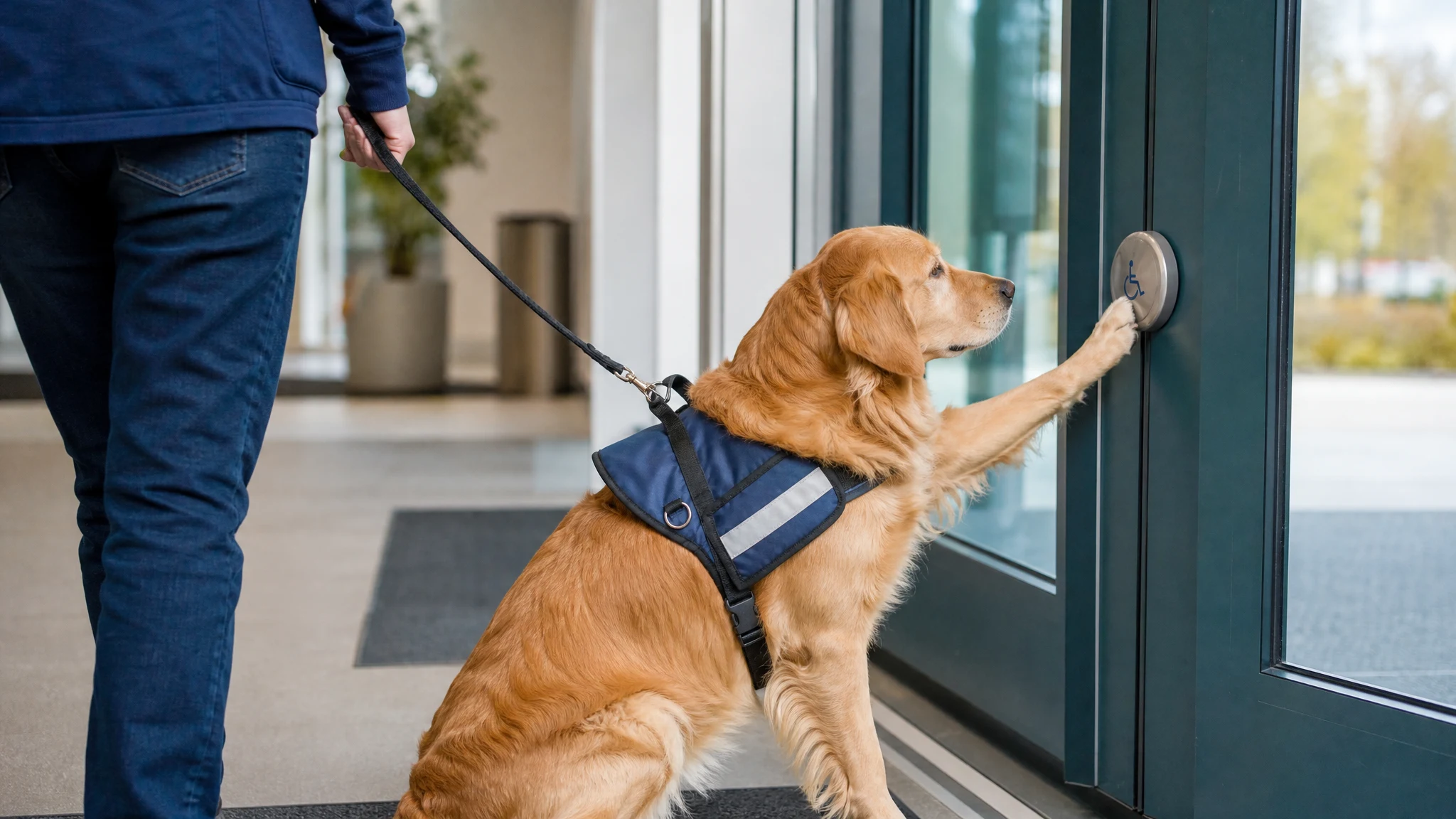
| Mobility | Retrieving dropped items, opening or closing doors, providing counterbalance or bracing support, pulling a manual wheelchair |
| Hearing | Alerting to a doorbell, smoke alarm, name being called or other important sounds |
| Vision | Guiding around obstacles, stopping at curbs and stairs |
| Psychiatric, including PTSD | Interrupting self-harming or repetitive behavior, turning on lights, creating space in a crowd, waking the person from nightmares |
| Autism | Interrupting repetitive behavior, guiding a person away from a hazard or overwhelming setting |
| Medical alert | Alerting to a change the dog has been trained to detect, fetching medication, getting help |
Massachusetts programs train for many of these needs. NEADS World Class Service Dogs in Princeton, which is listed in the Assistance Dogs International (ADI) Massachusetts member search, says it works with hearing, mobility, autism and military PTSD needs. Dogs for Better Lives in East Falmouth lists hearing and autism work, and Mobility Danes of New England in Ipswich lists mobility and balance. Each program sets its own eligibility, costs and waitlists, so check directly with the program.
Why comfort alone is not a task
A dog that calms you by being near you, or that makes you feel safe by its presence, is doing something valuable. But under the ADA definition, that is not work or a task. The dog has not been trained to do something in response to the disability.
Compare two cases. A dog that is simply nice to pet when someone feels anxious is providing comfort. A dog that is trained to nudge, lean or lie across a person's lap on cue to interrupt an anxiety episode is performing a task. The second is trained, repeatable and tied to the disability.
This is the distinction the ADA draws. It is not a judgment about how much a handler loves their dog or benefits from the bond.
What You Will Need
- A dog with a stable, friendly temperament and good health. Ask your own veterinarian about fitness for the work.
- A treat pouch and small, soft, high-value rewards
- A flat buckle collar or a well-fitted harness. Avoid shock, prong and choke collars.
- A standard six-foot leash
- A clicker or a consistent marker word, such as "yes"
- A notebook or phone to log training sessions and progress
- A written one-sentence description of each task
- A helper or two for distraction practice
- Access to real public settings, built up gradually
Step-by-Step: Define, Train and Check a Task
Step 1: Name the limitation and the task
Start with the disability-related need, not the dog. Write down what is hard for you, then write the specific behavior the dog would do. For example: "When I drop an item, my dog picks it up and puts it in my hand."
If the sentence reads "my dog makes me feel better," keep working. Look for an observable action that responds to a need.
Step 2: Break the task into small pieces
Split the behavior into steps your dog can learn one at a time. A retrieve, for instance, breaks into targeting the item, mouthing it, holding it, carrying it and delivering it to your hand. Reward each piece before chaining them together.
Training should be humane and reward-based, in line with the guidance of the American Veterinary Society of Animal Behavior (AVSAB). That means rewarding what you want, setting the dog up to succeed, and ending sessions before the dog is tired or frustrated.
Step 3: Put the task on cue or on trigger
Once the dog performs the pieces smoothly, attach a cue. A cue can be a word, a hand signal or a trigger such as a sound or a sign of distress. Add the cue just before the dog performs the behavior, and reward success.
Alert and response tasks take more time because the trigger must be real and consistent. Work with a qualified trainer experienced in that type of task.
Step 4: Practice in new places
Dogs do not automatically carry a skill from the living room to the pharmacy. Repeat each task in new rooms, outdoors, then in quiet public places. Raise difficulty slowly. If the dog fails, make the next attempt easier.
Step 5: Build solid public manners
Tasks matter only if the dog can stay calm while doing them. Work on loose-leash walking, settling under a table or chair, ignoring food and people, and recovering quickly after a surprise such as a dropped tray. This is what the public access test measures.
Step 6: Use the public access test as a benchmark
Many trainers use a public access test to check whether a dog is ready for regular outings. ADI, the accrediting body whose member programs include NEADS in Massachusetts, publishes a public access standard. Check ADI's own materials for the current wording, because this article describes the general idea only.
In general, a test like this looks at whether the dog:
- Walks calmly on a loose leash through crowds and doorways
- Stays settled when the handler stops, sits or eats
- Ignores dropped food, other animals and strangers who try to interact
- Responds reliably to basic cues despite distractions
- Stays clean, quiet and unobtrusive in places like shops, restaurants and transit
- Does not show fear, aggression or constant barking
You can run a practice version yourself. Have a helper watch and note any lapses. Treat the results as information about what to train next, not as a pass or fail that decides your rights.
Step 7: Keep records and keep training
Write down which tasks the dog knows, how reliable each one is, and where problems show up. Records help you notice patterns and help a trainer give better advice. They are not a legal requirement under the ADA.
The Public Access Test Is Not a Legal Requirement
This point is often misunderstood. The ADA does not require a service dog to pass a public access test, and a test certificate is not something a business can demand under the ADA. The ADA.gov FAQ limits what staff may ask to the two questions above.
That does not mean behavior is optional. The ADA.gov FAQ says a business may ask a handler to remove a service dog that is out of control when the handler does not take effective action, or that is not housebroken. The test is useful because it helps you reach the level of behavior that keeps you from being asked to leave.
How Massachusetts Law Fits In
Massachusetts General Laws chapter 272, section 98A gives blind, deaf, hearing-handicapped and other physically handicapped persons accompanied by a dog guide the same access to public conveyances, amusements and places of public accommodation as others. No extra charge may be imposed for the dog. The statute says a violation can bring a fine of up to $300, plus damages under chapter 151B, section 5.
Section 98A uses "dog guide" language and is narrower than the ADA definition. The ADA applies on top of it. Chapter 272, section 98 separately treats disability discrimination in public accommodations as a civil rights matter.
For training, Massachusetts General Laws chapter 129, section 39F says a person accompanied by and engaged in the raising or training of a service dog has the same rights, privileges and responsibilities as an individual with a disability under the ADA. The text read is not limited to professional trainers. For details on access rights and dogs in training, see our guide to service dogs in Massachusetts, training and access rights.
I could not verify a Massachusetts penalty for falsely claiming a pet is a service dog, a state ID program, or the state agency and process for filing a discrimination complaint. Check the Massachusetts Commission Against Discrimination and the legislature's website for current information. This is a general explanation of the law, not legal advice.
Tips and Common Mistakes to Avoid
- Confusing comfort with a task. Write the task as a trained behavior. If you cannot, it is probably comfort.
- Buying a registry, vest or certificate. None of these is required by the ADA or proves anything legally.
- Rushing into public. Add distractions in small steps. One bad outing can set training back.
- Using harsh tools or corrections. Shock, prong and choke collars and dominance methods can increase fear and stress. They are not part of reward-based training.
- Training only one task at a time and never combining them. Practice tasks in sequence so the dog can switch between them in real life.
- Ignoring the dog's welfare. Dogs need rest, play, vet care and time off duty. Some dogs are not suited to this work, and retiring or washing out a dog is a responsible decision.
- Treating the test as a one-time event. Behavior can slip. Recheck it regularly.
What to Expect
Progress varies a lot with the dog, the task and the handler's consistency. Many teams find that simple tasks come together over weeks to months, while complex alert tasks may take much longer. Some dogs may not reach the reliability needed for public work, even with good training.
With steady, reward-based practice, you may see your dog handle distractions more calmly and perform tasks more reliably in new places. No method can promise a particular result or timeline, and a trainer who works with service dog teams can help you judge readiness.
Sources
- ADA.gov Service Animals FAQ
- Massachusetts General Laws, c. 272, s. 98A
- Animal Legal & Historical Center, Massachusetts assistance animal and guide dog laws (c. 129, s. 39F)
- Massachusetts General Laws, c. 140, s. 139
- Assistance Dogs International, Massachusetts member search
- NEADS World Class Service Dogs
- Dogs for Better Lives
- Mobility Danes of New England